Biodiversity Character Areas have been developed by DERC to sit alongside Landscape Character Areas. They describe the landscape type and land use, main semi-natural habitats present and highlight species, species assemblages and features of particular interest.

Click here for a list of Key Species
The western Dorset chalk comprises wide valleys in the east running north-south with chalk streams, the River Cerne and Sydling Water, in the valley bottoms. The western chalk spur running from Maiden Newton to Chedington has the upper catchments of the River Frome and the River Hooke, the latter receiving some water from the more acidic Greensand to the south. This area of the chalk receives higher rainfall than elsewhere in Dorset which influences the vegetation. Here the more humid western and northern slopes are characterized by a local abundance of Devil’s Bit Scabious, the food plant for Marsh Fritillary and Narrow-bordered Bee Hawk. The warmer south-facing slopes are preferred by Adonis Blue, Dingy Skipper and Grizzled Skipper. Locally there are superficial deposits of clay-with-flints above the chalk which give rise to neutral and acid grassland, important for grassland fungi. Formerly heathland would have been present also.
Woodland is confined to the steeper slopes, particularly the northern scarp above Batcombe and at the head of Sydling Valley, some of these woodlands have been replanted with conifers. The remaining semi-natural areas have abundant Ash in the canopy and will be badly affected if or when Ash dieback takes hold. The ground flora holds uncommon species such as Bird’s-nest Orchid, Fly Orchid, Herb Paris and Wood Vetch. On the Toller ridge there are several woods with coppiced Sessile Oak over Bluebell, a scarce woodland type in the county. Around Minterne Magna House is a landscaped parkland which includes a significant number of veteran trees which support important lichen assemblages. The parkland and pasture trees are also a valuable habitat for bats, including Lesser Horseshoe and Noctule which are found in the area. Field trees, particularly Ash, are a feature at the foot of the down, but many of these are being lost and not replaced. The fields in the valley bottoms include a number of old water meadows, most of which have been abandoned and have developed into tall-herb fen. Important springline fens with rich invertebrate assemblages are found around Frome St Quintin, Kingombe, Rampisham and Woolcombe. The rivers are fed by springs arising in the chalk and have a typical chalk stream flora with abundant Brook Water-crowfoot; Otter and Water Vole use the river corridors.
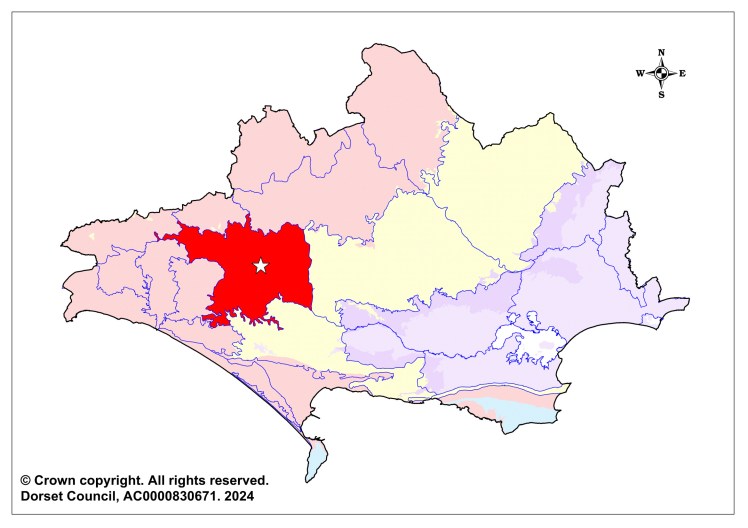
The Western Chalk BCA includes the Upper Frome Valley (valley and downland), Cerne & Sydling Valley (valley and downland), North Dorset Escarpment (chalk ridge/escarpment) and West Dorset Escarpment (chalk ridge/escarpment) Landscape Character Areas and covers 18,720 hectares.
Summary of Key Features
- Semi-natural chalk grassland on steep valley and scarp slopes with a rich flora and important butterfly populations
- Ancient woodland on steep and scarp slopes of the chalk
- Remnants of acid grassland rich in fungi on deeper soils overlying the chalk
- Parkland and veteran trees around Minterne Magna
- Base-rich fens around springlines with a rich flora and invertebrate fauna
- Chalk rivers and associated habitats
Issues:
- Fragmentation of chalk grassland and butterfly populations
- Lack of appropriate grazing levels to maintain the grassland habitats and the species they support
- Widespread loss of heathland and acid grassland on the Clay-with-Flint deposits above the chalk, only a few remnants remain notably at Rampisham Down
- The potential loss of Ash trees in the woodlands on the chalk scarp due to Ash Dieback
- Loss and lack of replacement of hedgerow and field trees
- Enrichment of watercourses
Species assemblages of importance within the BCA
- Butterflies and day-flying moths of grassland
Plants of ancient and unimproved grasslands
Fungi of ancient and unimproved grasslands
Invertebrates of species-rich scrub & scrub edges
Plants of ancient woodland
Fungi of old growth woodland
Lichens of old growth woodland
Fungi of wet woodland
Invertebrates of wet woodland
Saproxylic invertebrates associated with veteran trees and dead wood features
Woodland birds
Woodland bats
Invertebrates of fens, fen-meadows and basic flushes
Plants of open calcareous fens
Plants of species-rich hedgerows & hedgebanks
Plants of old droves, green lanes & Holloways
Invertebrates of species-rich hedgerows & hedgebanks
Lichens of mature and veteran wayside and pasture trees
Birds of lowland rivers
Lichens & bryophytes of churchyards
 Dorset Environmental Records Centre