Biodiversity Character Areas have been developed by DERC to sit alongside Landscape Character Areas. They describe the landscape type and land use, main semi-natural habitats present and highlight species, species assemblages and features of particular interest.

Click here for a list of Key Species


The area comprises the vale south of the chalk and is underlain by bands of clay and limestone producing a gently undulating landscape. Weymouth and nearby towns and villages form a significant part of the BCA. Within the conurbation are nationally important wetlands at Radipole and Lodmoor supporting large numbers of breeding, passage and wintering birds, as well as reedbeds and open water associated habitats include grazing marsh and, at Lodmoor, areas of saltmarsh. A number of rare invertebrates are present including the only recent UK sites for the spider Hypsosinga heri, and the Norfolk Hawker dragonfly has recently colonised the area and bred for the first time in Dorset.
The coastline from Furzy Cliff to Ringstead is mainly composed of clays producing distinctive slumping cliffs that are dynamic with an intimate mosaic of habitats including sparsely vegetated mud flows, open grasslands, seepages and scrub. The mainly southerly aspect produces a warm micro-climate favoured by many invertebrates. Bees, beetles and flies are particularly well represented including a number of scarce and rare species such as Cliff Furrow Bee, Longhorn Bee, Black-headed Mason Wasp and the hoverfly Chrysotoxum elegans. The coastline around Portland Harbour has lower clay cliffs with a number of scarce species.
Semi-natural grasslands are now very rare within the area, the most important being around Lorton where there are neutral swards with local plants of ancient grasslands including Adder’s-tongue Fern, Pepper Saxifrage, Grass Vetchling and Strawberry Clover. There are also more calcareous areas overlying the limestone.
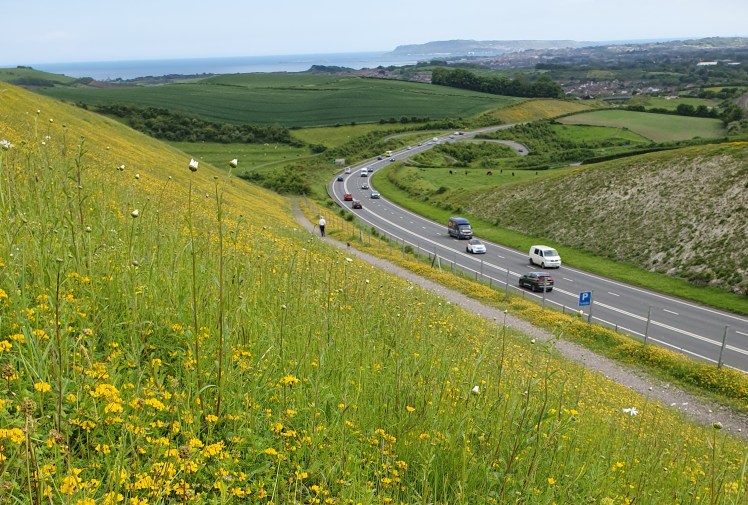
Since its construction, the cuttings of the Weymouth Relief Road which were sown with wildflowers are developing a more diverse grassland flora and have been colonised by many species of butterfly including scarce species such as the Small Blue. The road cuttings and associated land form an important ecological network through the conurbation.
The Southern & Weymouth Vales BCA includes the South Dorset Ridge & Vale (ridge and vale), Osmington Ridge & Vale (ridge and vale) and Weymouth Vales (ridge and vale) Landscape Character Areas and covers 6,008 hectares.
Summary of Key Features
- Nationally important wetlands within the Weymouth conurbation
- Nationally significant slumping clay cliffs with a rich and diverse invertebrate fauna
- Areas of semi-natural grassland with a small woodland and thick hedgerows at Lorton
Issues:
- Enrichment of watercourses and water bodies
- Fragmentation and lack of semi-natural habitat behind the cliff top
- Loss of semi-natural grasslands in the vales outside of the conurbation
- Continued development at the edges of the conurbation
Species assemblages of importance within the BCA
- Invertebrates of open sand & clay on slumping soft cliffs
- Invertebrates of seepages & flushes on slumping soft cliffs
- Breeding birds of reedbeds
- Wintering birds of coastal waters and mudflats
- Dragonflies & damselflies of ponds & lakes
- Invertebrates of reedbeds
- Plants of brackish ground and coastal grazing marsh
- Plants of middle & upper saltmarshes
- Plants of arable margins
- Breeding birds of scrub
 Dorset Environmental Records Centre