Biodiversity Character Areas have been developed by DERC to sit alongside Landscape Character Areas. They describe the landscape type and land use, main semi-natural habitats present and highlight species, species assemblages and features of particular interest.

Click here for a list of Key Species
Lying south of the Purbeck Ridge this area comprises the Wealden Valley which is predominantly agricultural with small hedged fields and a few small ancient woodlands. Corfe Common is a very important feature supporting one of the largest stands of acid grassland in the county, with fen-meadow and small-sedge fens in flushed areas. The largest remaining Dorset populations of Chamomile and English Eyebright are here, both requiring short, well-grazed turf. Other important areas of semi-natural grassland are found within the Lulworth Ranges around Tyneham. Woodland is scarce, with Langton West Wood and Tyneham Great Wood the largest. These have many mature and veteran trees with important assemblages of epiphytic lichens. At The Wilderness there are several large Elms that support a colony of the declining White-letter Hairstreak. At either end of valley are colourful clay and sand cliffs that are actively eroding producing a dynamic range of habitats favoured by many invertebrates with bees and flies of particular importance.
From Gad Cliff east to St Aldhelm’s Head is a long stretch of Kimmeridge Clay coastline characterised by dark grey, crumbling cliffs that are generally sparsely vegetated although Wild Cabbage is of particular note in places. Thin bands of hard, dolomitized limestone produce the distinctive intertidal ledges renowned for their marine flora and fauna. At Gad Cliff, Houn’s Tout and Emmett’s Hill the clay is backed by spectacular limestone cliffs. The wild undercliffs have a mosaic of grassland, scrub, boulders and seepages with a diverse range of species.
The limestone plateau is flat and exposed and characterised by limestone walls, some of which are hundreds of years old. The enclosures are grassland or arable and the area still retains an important arable flora including the last Dorset colony of Pheasant’s Eye. Farmland birds have declined but small numbers of Corn Bunting and Grey Partridge are still present. Sloping down to the cliff top the limestone pastures are famed for their flora including important populations of Bastard Toadflax, Early Gentian and Early Spider-orchid. The cliffs themselves have one of the few seabird colonies on the south coast with Guillemot, Razorbill and Kittiwake, plus Peregrine and Raven that have re-colonised in recent years. The caves and old mine adits are important for hibernating bats with most of the British species present.
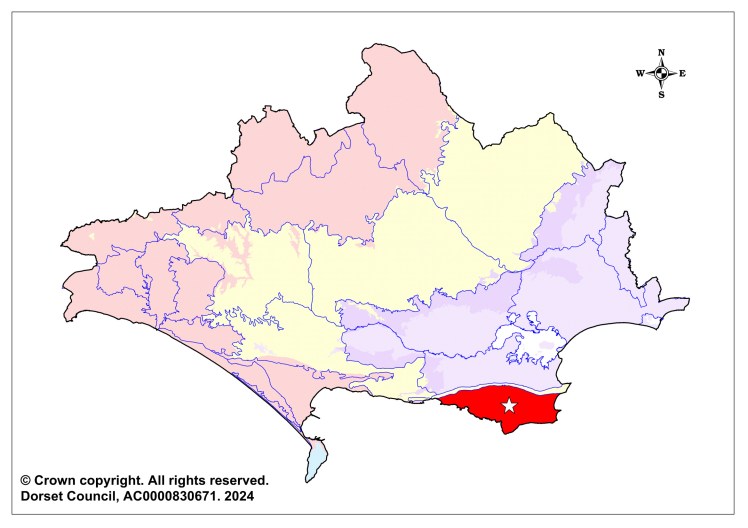
The South Purbeck BCA includes the Corfe Valley (clay valley), Kimmeridge Coast (clay valley) and Limestone Plateau (limestone plateau) Landscape Character Areas and covers 6,771 hectares.
Summary of Key Features
- Semi-natural limestone grassland on the coastal slope
- Ancient grazing common at Corfe Castle with large areas of acid grassland and fen-meadow
- Remnants of arable flora associated with cultivated land
- Ancient woodland with veteran trees
- Diverse maritime flora and fauna along the cliffs
- Rich intertidal and littoral flora and fauna on the Kimmeridge Clay coast
Issues:
- Lack of appropriate grazing to maintain the grassland habitats and species they support
- Buffering of cliff top vegetation along the Kimmeridge Clay coast
- High deer numbers preventing woodland regeneration and implementation of management
- Continuing decline of farmland birds and arable flora
- Loss and lack of replacement of field trees
- Enrichment of watercourses
Species assemblages of importance within the BCA
- Plants of cliffs ledges & maritime grassland
- Lichens of maritime rocks & boulders
- Bryophytes of sheltered maritime undercliffs
- Plants of slumping clay & sand cliffs
- Lichens & bryophytes of slumping clay & sand cliffs
- Invertebrates of open sand & clay on slumping soft cliffs
- Invertebrates of seepages & flushes on slumping soft cliffs
- Invertebrates of cliff slopes & maritime grasslands
- Breeding birds of sea cliffs
- Plants of open, rocky chalk & limestone
- Bryophytes & lichens of open & rocky chalk & limestone grassland
- Butterflies and day-flying moths of chalk & limestone grassland
- Invertebrates of species-rich scrub & scrub edges
- Grassland bees & bumblebees
- Breeding birds of scrub
- Plants of ancient woodland
- Plants of wet woodland
- Lichens of old growth woodland
- Lichens of mature and veteran wayside and pasture trees
- Saproxylic invertebrates associated with veteran trees and dead wood features
- Woodland birds
- Woodland bats
- Plants of rush-pastures & fen-meadows
- Invertebrates of fens, fen-meadows and basic flushes
- Plants of ancient and unimproved grasslands
- Fungi of ancient and unimproved grasslands
- Plants of acid flushes and mires
- Plants of species-rich hedgerows & hedgebanks
- Invertebrates of species-rich hedgerows & hedgebanks
- Arable plants of cultivated field margins
- Farmland birds
 Dorset Environmental Records Centre