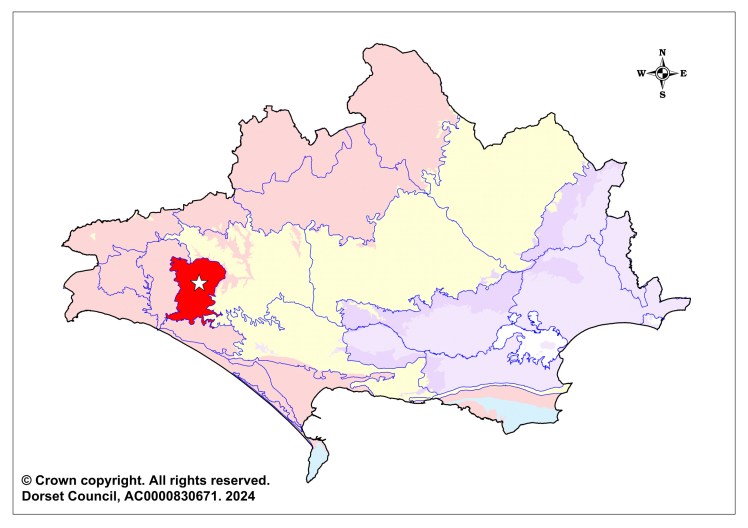
Biodiversity Character Areas have been developed by DERC to sit alongside Landscape Character Areas. They describe the landscape type and land use, main semi-natural habitats present and highlight species, species assemblages and features of particular interest.

Click here for a list of Key Species
A very distinctive undulating landscape of small, hedged fields, and deeply cut streams in the valley bottoms and narrow roads connecting the small settlements.
The eastern part of the area overlies the Fuller’s Earth which produces a seasonally wet soil that is unsuitable for cultivation. This area has the largest extent of woodland and much of the grassland is used for grazing. There are significant areas of ancient landslips which produce an undulating landscape; locally small acid mires have formed in hollows, a rare feature in this part of Dorset, with stands of wet Alder and Sallow woodland. The fields are small and irregular, some are ancient other more recent and the result of enclosing common land. Nationally significant areas of species-rich grassland and rush-pasture are found around Lower Kingcombe where there is a rich flora and assemblage of grassland fungi.
The western part has a very distinctive landscape characterised by steep-sided valleys cut through the soft Bridport Sands with conical hills and flat-topped ridges where there are outcrops of harder Oolitic Limestone. Numerous small streams drain south and west into the Mangerton River and further south the River Asker. The streams are quite natural with meanders, small areas of mobile gravel and are often tree-lined with Alder and Sallow or flow though wet woodland in valley bottoms.
The small villages, large farmsteads and manor houses are built of the local honey-coloured limestone. The roads that connect these settlements are narrow and winding with steep banks that have a rich and colourful flora especially in the spring. A particular feature around Powerstock – West Milton – Loscombe area are the deeply cut Holloways which are double-hedged or tree-lined and act as important ecological networks through the landscape especially for birds and mammals.
The Powerstock Hills & Woods BCA includes the Powerstock Woods (wooded hills) Landscape Character Area and covers 5,224 hectares.
Summary of Key Features
- Clay & sand soft cliff coast line of international geological and biological importance
- Acid-capped hills with acid grassland and heathland
- Irregular shaped hedged fields
- Remnants of neutral grassland with a rich flora
Issues:
- Loss and fragmentation of semi-natural grassland
- Historic loss of common land, heath and mire habitat through enclosure and tree planting
- Enrichment of watercourses
- Loss of and lack of replacement for pasture trees
Species assemblages of importance within the BCA
- Plants of ancient woodland
- Plants of wet woodland
- Fungi of old growth woodland
- Fungi of wet woodland
- Lichens of old growth woodland
- Lichens of mature and veteran wayside and pasture trees
- Saproxylic invertebrates associated with veteran trees and dead wood features
- Invertebrates of wet woodland
- Woodland birds
- Woodland bats
- Plants of ancient and unimproved grasslands
- Plants of rush-pastures & fen-meadows
- Plants of acid flushes and mires
- Fungi of ancient and unimproved grasslands
- Butterflies and day-flying moths of grassland
- Invertebrates of fens, fen-meadows and basic flushes
- Plants of species-rich hedgerows & hedgebanks
- Invertebrates of species-rich hedgerows & hedgebanks
- Plants of old droves, green lanes & Holloways
- Birds of lowland rivers
 Dorset Environmental Records Centre