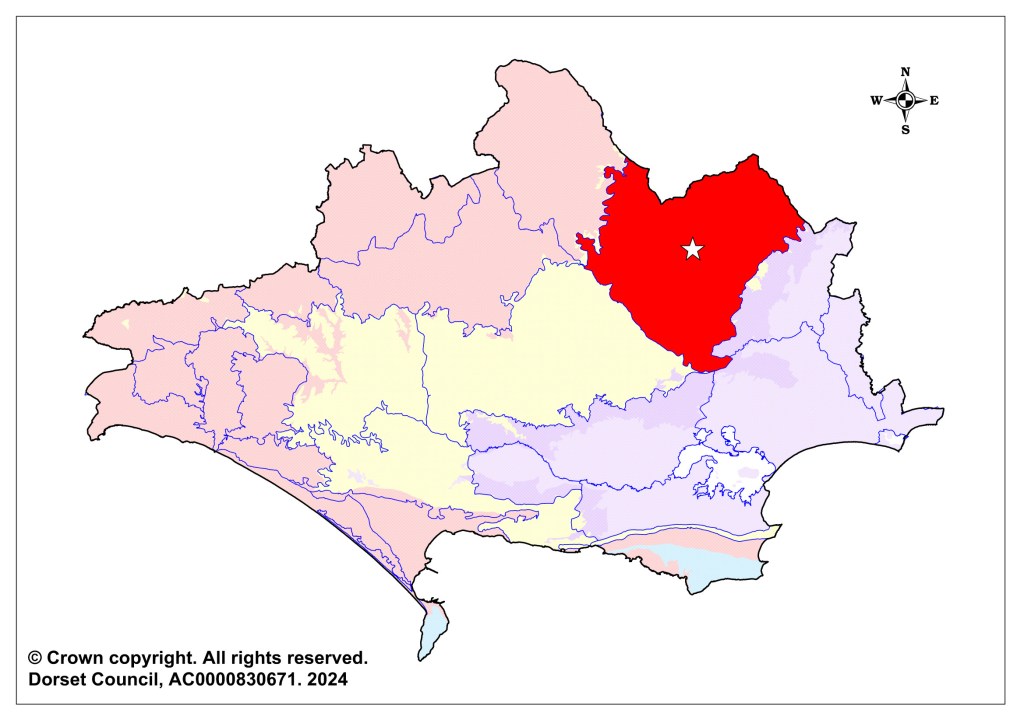
Biodiversity Character Areas have been developed by DERC to sit alongside Landscape Character Areas. They describe the landscape type and land use, main semi-natural habitats present and highlight species, species assemblages and features of particular interest.
Click here for a list of Key Species (coming shortly)
This area comprises the chalk outcrop from Child Okeford north to Melbury Abbas and east to the Dorset – Hampshire border. Some of the most species-rich chalk grassland in the county is present on steep slopes from Hambledon Hill north to Melbury Hill. The majority of the much gentler dip slope is now arable farming although both sheep and cattle are still present locally, with unimproved grassland largely confined to ancient earthworks such as Ackling Dyke and Badbury Rings. Chalk grasslands have nationally important populations of Bastard Toadflax, Dwarf Sedge and Early Gentian, plus our few remaining bushes of Juniper. Butterflies include the sole remaining colony of Silver-spotted Skipper, with populations Adonis Blue, Chalk Hill Blue, Small Blue and Marsh Fritillary also present.
Along the Dorset – Wiltshire border Cranborne Chase is the largest remaining block of ancient woodland in Dorset. It has had a varied history with some areas of wood-pasture plus extensive areas of Hazel coppice. Other significant woodland areas are present at Ashley Wood, Chetterwood and Stubhampton Bottom, smaller in extent but retaining a rich flora and fauna. The ancient woodlands have a rich flora including Solomon’s Seal, Herb Paris, Toothwort, Wild Liquorice and Narrow-lipped Helleborine. The decline of active coppicing has resulted in the decline or loss of some woodland butterflies and moths, although there are still important populations of White Admiral, Purple Emperor and Drab Looper. There are numerous veteran trees, particularly Ash and Maple, which provide a habitat for deadwood (saproxylic) invertebrates and epiphytic lichens, plus a rich assemblage of woodland bats. Parklands mostly originate from formal plantings but encompass older native trees such as Ash, Maple and Oak.
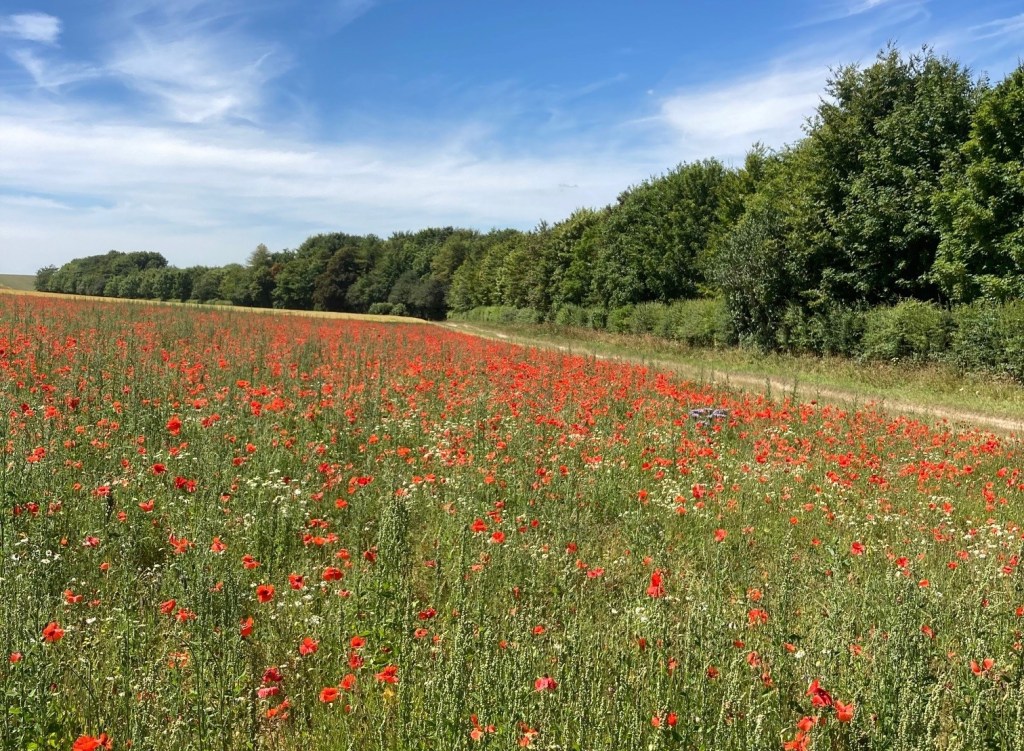
The arable land historically had the richest arable flora in the county. Whilst there have been some losses, scarce and threatened species are still present including Dense-flowered Fumitory, Narrrow-fruited Cornsalad, Night-flowering Catchfly and Venus’-looking-glass. Farmland birds such as Corn Bunting are widespread with Grey Partridge present locally. Agri-environment schemes have benefited many species by the establishment of flowery margins, beetle banks and the sowing of pollinator and winter bird mixes.
Chalk streams, some flowing only in winter and spring, including the Crane, Tarrant and Gussage Stream, flow south and east into the Stour and Tarrant. These are characterised by an abundance of Stream Water-crowfoot, a key species in the ecology of these water courses. The River Allen still supports a few unimproved flood-meadows and fen-meadows with a rich flora including Bistort and Early Marsh-orchid, plus the only remaining population of Flat-sedge in the county.
Blandford is the only town, situated by the Stour in the southwest of the area. There are numerous small villages in the smaller river valleys with their distinctive churches built of stone and flint. Churchyards are important for their lichens and veteran Yew trees.
The Northeast Chalk BCA falls within the following Landscape Character Areas: North Dorset Chalk Escarpment (chalk ridge/escarpment), Cranborne Chase Wooded Chalk (wooded chalk downland), Northeast Dorset Chalk Dip Slope (chalk valley downland, open chalk downland). It covers 29,930 hectares.
Summary of Key Features
- The most extensive areas of semi-natural ancient woodland remaining in Dorset in Cranborne Chase along the Wiltshire border
- Large areas of unimproved chalk grassland on the steep scarp slope of the chalk from Child Okeford north to Melbury Abbas. Remnants of chalk grassland on the gentler dip slope of the chalk especially ancient monuments including Ackling Dyke and Badbury Rings
- A rich arable flora and bird fauna
- Chalk streams and rivers notably the Allen and Tarrant plus the headwaters of the Crane
- The central Stour Valley forming the southern boundary
Issues:
- Loss and fragmentation of semi-natural habitats, particularly ancient and unimproved chalk grassland
- Enrichment of watercourses
- Loss and lack of replacement of hedgerow and field trees
Species assemblages of importance within the BCA
- Plants of ancient & long-established woodland
- Moths of ancient & long-established woodland & parkland
- Ecto-mycorrhizal & saprotrophic fungi of ancient and long-established woodland
- Woodland birds
- Woodland bats
- Plants of open woodland, glades, rides & early stage coppice
- Invertebrates of open woodland, glades, rides & early stage coppice
- Butterflies & day-flying moths of open woodland & early stage coppice
- Saproxylic Invertebrates associated with dead wood habitats and veteran trees in old growth woodland
- Lichens of old growth woodland & wood-pasture
- Bracket, crust & other saprotrophic fungi of old growth woodland & wood-pasture
- Butterflies and day-flying moths of chalk & limestone grassland
- Plants of short, open chalk & limestone grassland
- Bryophytes & lichens of short, open chalk & limestone grassland
- Invertebrates of open, species-rich calcareous grassland
- Plants of longer calcareous grassland, scrub edge & marginal habitats
- Invertebrates of species-rich scrub edge & marginal habitats
- Plants of tall-herb fens, swamps & reedbeds
- Riparian dragonflies & damselflies
- Invertebrates of chalk streams
- Breeding farmland birds
- Wintering farmland birds
- Arable plants of cultivated field margins
- Invertebrates of field margins
- Lichens, fungi & bryophytes of mature and veteran wayside & pasture trees
- Lichens & bryophytes of churchyards
 Dorset Environmental Records Centre