Biodiversity Character Areas have been developed by DERC to sit alongside Landscape Character Areas. They describe the landscape type and land use, main semi-natural habitats present and highlight species, species assemblages and features of particular interest.
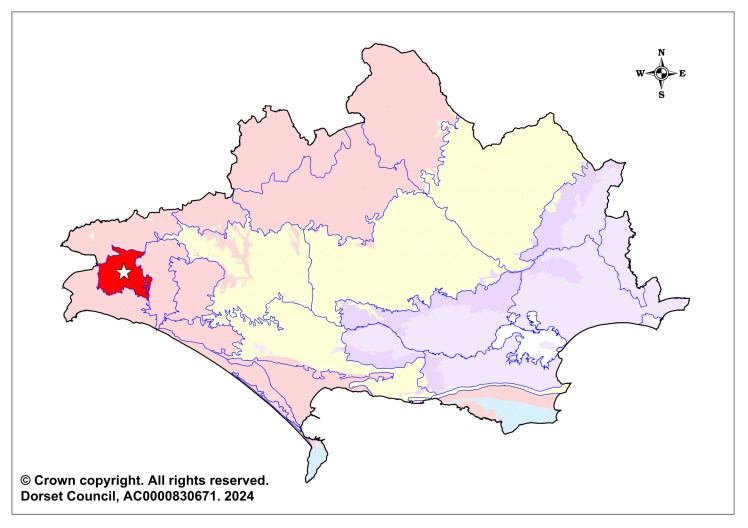

Click here for a list of Key Species
Ringed by hills, the bowl of the Marshwood Vale overlies the Lias Clay formation and is an agricultural landscape characterized by small and medium-sized hedged fields, the hedges often with scattered mature Oak trees. Whitchurch Canonicorum is the main village lying in the southwest of the area, the small settlements and farmsteads are scattered but often ancient with some mentioned in the Domesday Book. The River Char and its tributaries are used by Otter and Water Vole.
The clay soils favour grass production for dairy and beef farming with semi-natural grassland now rare and confined to a few isolated fields, although restoration projects such as Pastures New are helping to address this situation. Remnants of the rich grassland flora can also be found along the road verges notably along Mutton Street.
Woodland is confined to the northern and western areas of the Vale, many of which are narrow and run alongside streams. Prime Coppice is the largest ancient woodland and traditional woodland management practices have been re-introduced here. Lewesdon Hill has small areas of ancient woodland on the slopes but the summit has an interesting old Beech plantation with many fine trees which have features of veterans.
The hills to the north separate the area from the Axe catchment with the flat-topped profile of Pilsdon Pen a distinctive feature. The ramparts of the Iron Age hillfort and surrounding slopes support remnants of heath, western type with Western Gorse and Bilberry, with acid grassland in the flatter centre. As important is an acid flush with Sphagnum mosses, a rare feature of this part of the county, supporting plants such as Bog Pimpernel and Cottongrass and the only site in West Dorset for Pale Butterwort. The hill slopes retain areas of unimproved acid and neutral grassland with a rich grassland fungal assemblage of international importance.
The Marshwood Vale BCA falls within the Marshwood Vale Landscape Character Area (clay valley) and covers 5,615 hectares.
Summary of Key Features
- Remnants of neutral grassland with a rich flora
- Hill slopes on the northern edge of the vale with acid grassland
- Hedged fields with mature Oak trees
- Network of small lanes with a rich verge flora
- Streams and small rivers
Issues:
- Loss and fragmentation of semi-natural grassland
- Enrichment of road verges with rank nutrient rich vegetation replacing semi-natural grassland vegetation
- Enrichment of watercourses
- Loss and lack of replacement of hedgerow and field trees
Species assemblages of importance within the BCA
- Plants of ancient woodland
- Plants of wet woodland
- Invertebrates of wet woodland
- Woodland birds
- Woodland bats
- Plants of ancient and unimproved grasslands
- Plants of open, parched acid grassland
- Plants of rush-pastures & fen-meadows
- Fungi of ancient and unimproved grasslands
- Butterflies and day-flying moths of grassland
- Plants of species-rich hedgerows & hedgebanks
- Invertebrates of species-rich hedgerows & hedgebanks
- Lichens & bryophytes of churchyards
 Dorset Environmental Records Centre