Biodiversity Character Areas have been developed by DERC to sit alongside Landscape Character Areas. They describe the landscape type and land use, main semi-natural habitats present and highlight species, species assemblages and features of particular interest.


Click here for a list of Key Species

The coast
Portland is a tied island connected to the mainland by a tombolo at the Chesil Beach, a shingle storm beach. Together these form one of the most distinctive and important geological and geomorphological regions in the country. The Island is essentially a block of limestone sitting on a bed of Kimmeridge clay, and dips to the south, from a height of 150 metres at The Verne to around 16 metres at Portland Bill. Landslips fringe much of the coastline except from Southwell to The Bill on the east side and from below Lloyd’s Cottage to The Bill on the west side, here there is a small seabird colony with Guillemot, Razorbill, Kittiwake and a small number of Puffins. The rich maritime flora around the Bill includes abundant Thrift, Golden Samphire and Wild Carrot all of which are important nectar sources for invertebrates. The area has long been known for the endemic Portland Sea-lavender which grows locally on sparsely vegetated cliff ledges. The rare Prostrate Asparagus has recently been re-introduced after the colony was destroyed by quarrying.
Further north the undercliffs are backed in places by spectacular cliffs showing exposures of Portland Sand and the sequences of the Portland Stone formation, the white limestone contrasting with dark grey bands of chert. The wide and more sheltered eastern undercliffs were quarried out quite early leaving boulders of Chert and the Roach bed limestone which have become colonised by a bryophyte and lichen assemblage of national importance, including three lichens not currently known elsewhere in Britain. Now ungrazed the undercliffs are a mosaic of grassland, scrub, boulders and scree (former quarry waste), the relatively sheltered conditions of the eastern side providing an ideal micro-climate for invertebrates.
Most of the shoreline is dominated by boulders but locally there are small shingle beaches. The largest of these at Grove Point is sparsely vegetated with scattered clumps of Sea Kale. The two ancient salt pans here are tidal and are fringed by open saltmarsh with scarce plants including One-flowered Glasswort, Curved Hard-grass and the endemic sea-lavender Limonium recurviforme.
Top hill
Until the mid-nineteenth century agricultural land occupied much of the open land on the island, mostly used for corn and sheep. Much of the agricultural land in the centre and north of the Island was lost to quarry during the latter half of the 19th Century and more recently to development. However, large areas of the open field system survive between Southwell and the Bill Common. It was this area that until the mid-1970s supported a very rich arable flora. For the last 30 years this area has been used for grazing and making hay, resulting in a rapid decline in the arable flora. More recently Portland Bird Observatory has purchased land and is cultivating strips, sowing them with seed mixes and crops to attract passage and wintering birds, this is also benefiting the flora.
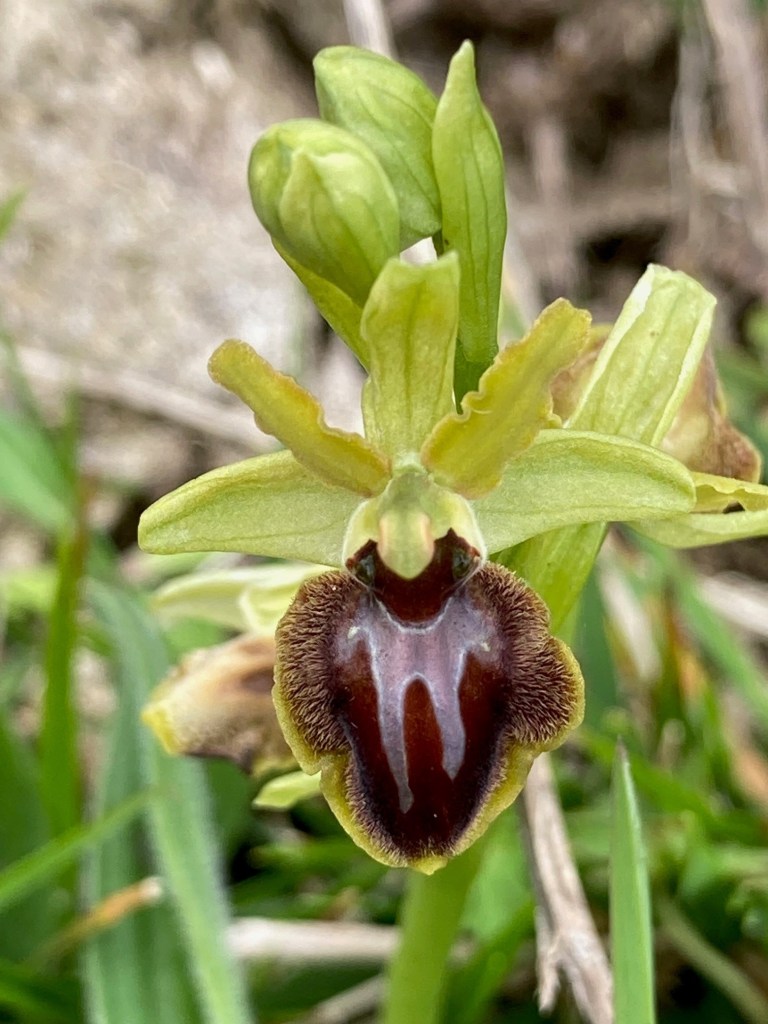
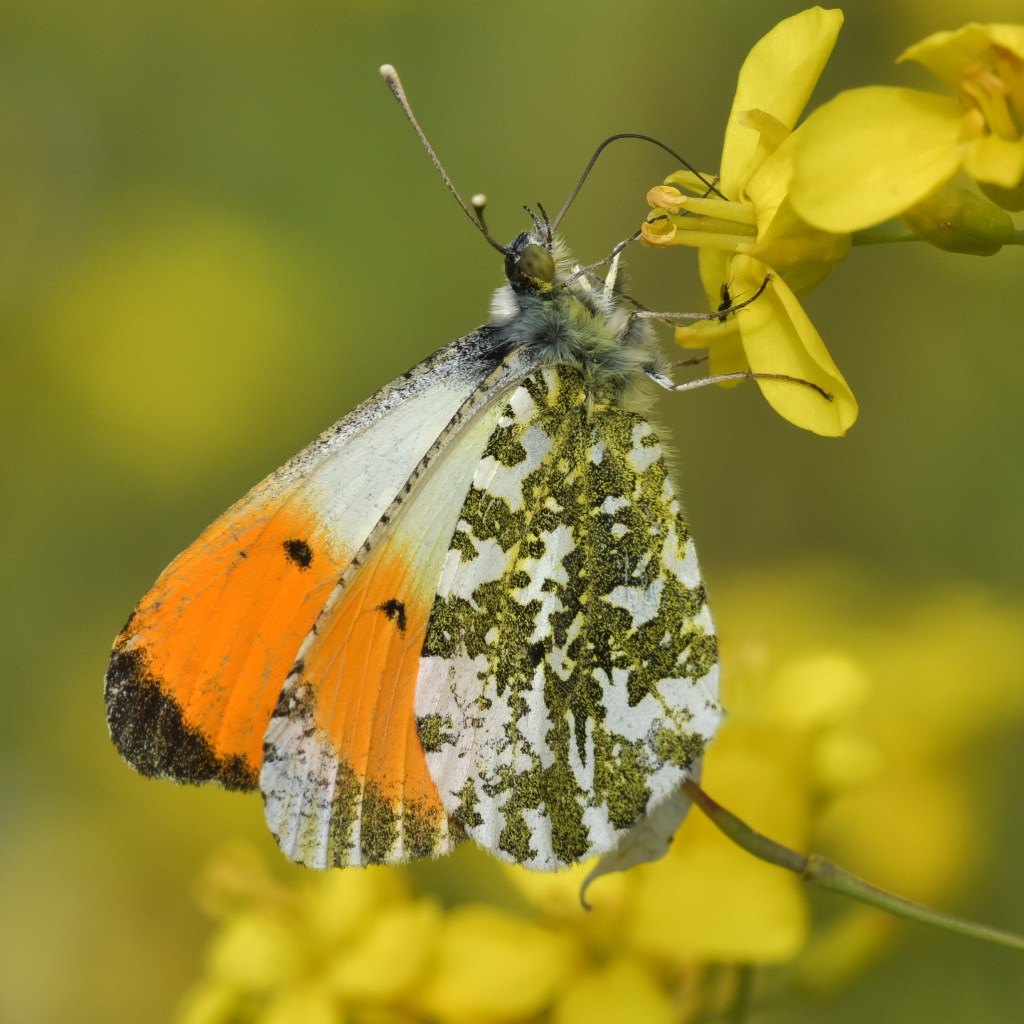
The nationally important areas of limestone grassland which vary in their structure are found on the old commons and in and around abandoned quarries. Taller swards are dominated by Tor-grass and Upright Brome while the more open and summer-parched turf has abundant Sheep’s Fescue with extensive patches of mosses, these areas tend to support more rare species including several populations of Early Gentian. The mild climate means that several Mediterranean species reach the northern limit of their distribution here, including the largest UK populations of the liverwort Southbya nigrella. The abandoned quarries provide a sheltered environment for many invertebrates particularly important for butterflies, notably Chalkhill Blue, Small Blue and a limestone form of the Silver-studded Blue. Lulworth Skipper has colonised the Island and is now locally frequent in taller grasslands where its foodplant Tor-grass is abundant.
The Isle of Portland BCA falls within the Isle of Portland Landscape Character Area (Limestone peninsula) and covers 1,103 hectares.
Summary of Key Features
- Nationally important limestone flora and fauna
- Spectacular coastline with vertical cliffs and wide undercliffs with very rich maritime flora
- One of the few seabird colonies on the South Coast
- Mild climate with many species that have a Mediterranean-Atlantic distribution within Europe
- Internationally geological and geomorphological features
Issues:
- Fragmentation of the limestone grassland due to large-scale quarrying and development
- Lack of appropriate grazing to maintain the grassland habitats and species they support
- Decline of farmland birds and arable flora
- Visitor pressure around Portland Bill
Species assemblages of importance within the BCA
- Plants of short, open chalk & limestone grassland
- Bryophytes & lichens of short, open chalk & limestone grassland
- Butterflies and day-flying moths of chalk & limestone grassland
- Invertebrates of short, open chalk & limestone grassland
- Grassland bees & bumblebees
- Fungi of ancient and unimproved grasslands
- Plants of cliffs ledges & maritime grassland
- Bryophytes of sheltered maritime undercliffs
- Lichens of limestone boulders and rock outcrops
- Lichens of maritime rocks & boulders
- Invertebrates of cliff slopes & maritime grasslands
- Invertebrates of open sand & clay on slumping soft cliffs
- Invertebrates of species-rich scrub & scrub edges
- Plants of arable field margins
- Breeding seabirds
- Breeding birds associated with scrub
 Dorset Environmental Records Centre