Biodiversity Character Areas have been developed by DERC to sit alongside Landscape Character Areas. They describe the landscape type and land use, main semi-natural habitats present and highlight species, species assemblages and features of particular interest.

Click here for a list of Key Species (coming shortly)
Much of the area away from the Moors and Avon floodplains was historically heathland. Over the last two centuries this has been significantly reduced and fragmented by development and the extensive post-war planting of conifers. The largest remaining fragments are all protected as SSSI and SAC and found at Avon Heath Country Park, with MoD land at Barnsfield Heath and at Sopley and Town Commons either side of the A338. Dry, humid and wet heath dominates, but there are few extensive valley mires compared with the Purbeck Heaths. Many of the specialist bird, invertebrate, plant and reptile species are present. Associated with the heaths are areas of acid grassland, these often originated from land enclosed from the heath and used for arable land but then abandoned as agriculture became unviable. These summer-parched grassland support an assemblage of early flowering annuals such as Smooth Cat’s-ear plus the only recent Dorset sites for the rare Deptford Pink and scarce Small Adder’s-tongue.
The floodplains of the Moors and Avon are on richer alluvial soils and were enclosed and drained early to provide grazing land for hay production. Today there are fragments of species-rich neutral grasslands, plus wetter flood-meadows, rush-pasture and fen-meadow, particularly in the lower Avon Valley. These have a rich flora and include scarce and declining species such as Early Marsh-orchid, Marsh Cinquefoil, Water Avens, Tubular Water-dropwort and the only remaining Dorset population of Marsh Stitchwort. Where grazing has ceased secondary wet woodland has developed with Alder on richer soils supporting nationally important populations of the rare Elongated Sedge in its only Dorset sites; over more acidic peats Downy Birch dominates. In places there are small stands of tall fen with a rich flora and invertebrate fauna.
In the winter the flooded meadows in the lower Avon can attract important numbers of waterfowl and waders with significant numbers of Black-tailed Godwit and Lapwing in particular. In the summer stands of Common Reed and willow scrub are home to Cetti’s, Reed and Sedge Warblers and Reed Bunting. The Moors River is renowned for its dragonflies and damselflies with Scarce Chaser, Brown Hawker and White-legged Damselfly of particular note. Otters are found along both rivers and Water Voles are present locally.
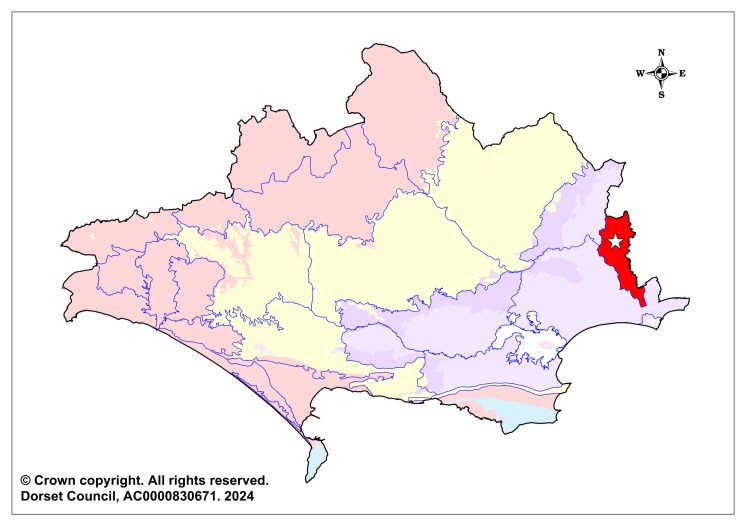
The Eastern Heaths and Avon Valley BCA falls within the Eastern Heaths and Avon Valley Landscape Character Area (heath/forest mosaic & valley pasture) and covers 3,975 hectares.
Summary of Key Features
- Significant areas of lowland heathland & with small mires supporting many scarce and threatened species typical of the Dorset Heaths
- Parched acid grasslands associated with the heaths with a rich flora
- The floodplains of the Moors River and River Avon with areas of species-rich neutral and floodplain grassland, plus stands of tall-herb fen, reedbed and wet woodland
- The Moors River has an important assemblage of dragonflies and damselflies and the River Avon is important for migratory fish.
Issues:
- Loss and fragmentation of semi-natural habitats, particularly the heaths
- Urban
- Enrichment of watercourses
- Loss and lack of replacement of hedgerow and field trees
Species assemblages of importance within the BCA
- Invertebrates of bare ground on sandy & clayey heaths
- Invertebrates of mature and senescent stages of dry heath
- Invertebrates of wet heaths
- Invertebrates of heathland edge & marginal habitats
- Plants of dry & humid heath and grass-heath
- Plants of open, peaty, winter-wet hollows on wet heath
- Plants of heathland trackways
- Plants of open valley mires & acid flushes
- Bryophytes of valley mires & acid flushes
- Invertebrates of open Sphagnum-rich valley mires
- Dragonflies & damselflies of mires and acid pools
- Heathland birds
- Plants of ancient & long-established woodland
- Lichens of old growth woodland & wood-pasture
- Saproxylic Invertebrates associated with dead wood habitats and veteran trees in old growth woodland
- Moths of ancient & long-established woodland & parkland
- Woodland birds
- Woodland bats
- Plants of wet woodland
- Plants of rush-pastures & fen-meadows
- Invertebrates of fens, fen-meadows & rush-pastures
- Riparian dragonflies & damselflies
 Dorset Environmental Records Centre