Biodiversity Character Areas have been developed by DERC to sit alongside Landscape Character Areas. They describe the landscape type and land use, main semi-natural habitats present and highlight species, species assemblages and features of particular interest.

Click here for a list of Key Species
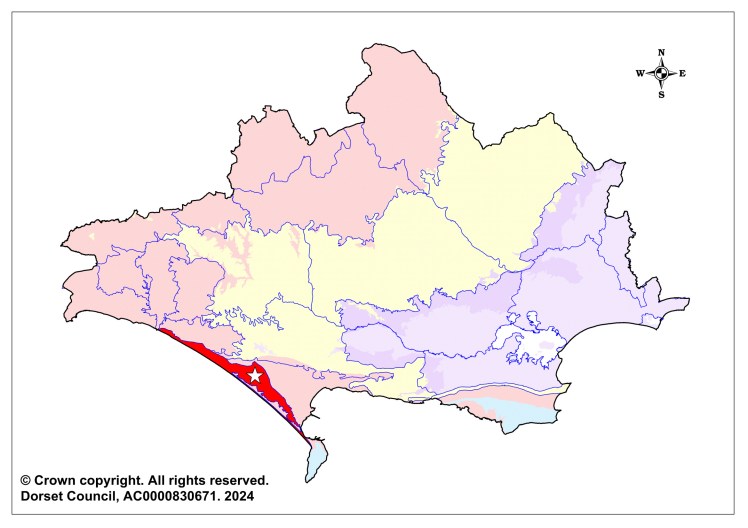
This BCA is dominated by the internationally important features of Chesil Beach and The Fleet lagoon between West Bay and Portland. Bands of clay and limestone underlie the area producing a gently undulating landscape inland with the harder limestone producing low ridges. Soils are mainly clayey and in places moderately calcareous in nature where underlain by Oolitic limestone. Farmland dominates much of the gentle slope up to the coast road (B3157) with only small areas of species-rich neutral to calcareous grassland, particularly on National Trust land around Burton Bradstock and Cogden. Behind Chesil Beach and the Fleet there are important brackish wetland features including reedbed, grazing marsh and salt-marsh.
The Chesil Bank is one of the three major shingle structures in Britain and is of both biological and geomorphological importance. The more stabilised parts on the landwards slope and at the back of the beach supports vegetated shingle including the largest populations of Sea Kale and Sea Pea in Britain plus a wide range of associated species including several invertebrates confined to shingle habitats in the UK such as the Shingle Yellow-face Bee, the jumping spider Pellenes tripunctatus and Scaly Cricket. Where the Fleet lagoon backs onto the beach interesting saltmarsh-shingle transitions are present including large stands of Shrubby Seablite scrub. At the Portland end there is a mixture of blown shingle with a particularly rich flora including one of the few native sites in Britain for Four-leaved Allseed.
The Fleet lagoon has extensive eel-grass beds west of Lynch Cove and there are also nationally important populations of Spiral Tasselweed and Foxtail Stonewort. There are narrow stands of saltmarsh at the landward edge of the Fleet which includes the largest Dorset populations of the Near Threatened Marsh Mallow. Numbers of wintering waterbirds on the Fleet averaged just over 14,500 birds between 2015 and 20201 and it has internationally significant numbers of Dark-bellied Brent Goose and Mute Swan, with nationally important numbers of five other species. Small brackish wetlands are found at Abbotsbury, Bexington and Cogden with reedbeds and grazing marsh. These are important for breeding, wintering and migrating birds as well as supporting a diverse flora.
The farmland on the coastal slope is mixed with cattle, sheep and arable. The arable flora has declined but several scarce species survive at Labour-in-Vain Farm where the field margins are managed sympathetically. Species-rich grassland is now scarce and largely confined to the limestone at Abbotsbury and clays at Cogden and Tidmoor Point, the last two sites are notable for large populations of the Vulnerable Dyer’s Greenweed plus its associated scarce micromoths. There is a good series of ponds in the Bexington – Cogden area known to support Great Crested Newt and a good range of invertebrates and plants.
The Chesil & Fleet Coastline BCA falls within the Chesil Beach (shingle beach), The Fleet (tidal water), Bexington Coast (coastal grassland) and South Dorset Ridge & Vale Landscape Character Areas and covers 3,519 hectares.
Summary of Key Features
- Chesil Beach with stands of vegetated shingle on the more stabilised areas supporting a specialised flora and fauna.
- The Fleet, the largest saline lagoon in Britain with a very rich fauna including a number of species not found elsewhere in Britain
- Brackish grazing marsh and reedbeds at Abbotsbury, Bexington and Cogden
- Limestone and sandstone cliffs between West Bay and Hive Beach, and low clay cliffs at the back of the Fleet with maritime communities and species
- Areas of species-rich neutral and calcareous grassland on the slope behind the beach and lagoon
Issues:
- Water quality issues leading into the The Fleet
- Visitor pressure at ‘hot spots’ around car parks, particularly at the Portland end and West Bay ends
- Continuing decline of farmland birds and arable flora on the farmland
Species assemblages of importance within the BCA
- Plants of open stabilised shingle
- Plants of shingle grassland
- Lichens of stabilised shingle
- Invertebrates of stabilised & vegetated shingle
- Invertebrates associated with maritime cliffs & coastal grasslands
- Invertebrates of open sand & clay on slumping soft cliffs
- Plants of brackish grazing marsh
- Plants of pioneer & lower saltmarshes
- Plants of middle & upper saltmarshes
- Birds of reedbeds
- Wintering birds of coastal waters and mudflats
- Plants of arable margins
- Breeding birds of scrub
 Dorset Environmental Records Centre