Biodiversity Character Areas have been developed by DERC to sit alongside Landscape Character Areas. They describe the landscape type and land use, main semi-natural habitats present and highlight species, species assemblages and features of particular interest.

Click here for a list of Key Species
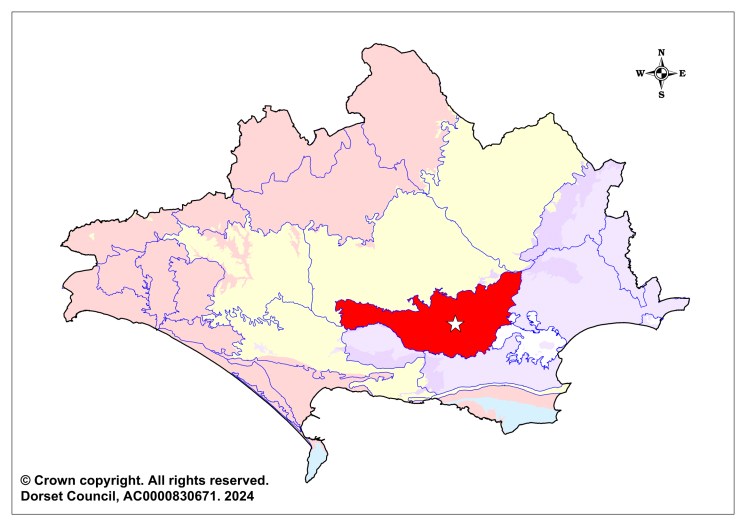
This BCA comprises the Poole Basin heaths north of the River Frome from Puddletown Forest in the west to the shore of Poole Harbour in the east, the southern edge of the Central Dorset Chalk forms the northern boundary. Maps from the early 19th Century show that 200 years ago much of this area was open heath split by the River Piddle. Over the last two centuries agriculture and forestry have led to the heaths becoming smaller and more fragmented. Along the northern edge overlying the London Clays are a series of Ancient Woodlands many of which in the past were managed by coppicing particularly around the Bloxworth-Morden area. Agriculture is the main industry on the more fertile soils, and mineral extraction is a particular feature of the heathland ridge along the Puddletown Road.
There are still significant areas of heathland today protected within various Sites of Special Scientific Interest with two National Nature Reserves at Holton Heath and Morden Bog. Although much heathland has been planted to pine plantation there has been some more sympathetic management within forestry areas such as creating heath strips along rides to join up and expand existing areas of heathland; there has also been restoration work on several previously drained mire systems. On the surviving heaths many rare and threatened specialist birds, invertebrates, reptiles and plants are present.
To the north of the heaths the woods on the London Clay were formerly managed as coppice-with-standards and historically supported woodland specialist butterflies such as Pearl-bordered Fritillary but due to the decline in coppice management only Silver-washed Fritillary survives. The woods from Affpuddle to Lytchett Matravers are the stronghold for the Nationally Scarce Narrow-leaved Lungwort which has a very restricted distribution in Britain. Oakers Wood is noted for its rich assemblage of lichens associated with old growth woodland.
The lower sections of the Frome and Piddle are good examples of chalk rivers with a diverse flora and fauna and are important for freshwater and migratory fish. Native White-clawed Crayfish has been recorded from the Bere Stream. Interesting fen vegetation has developed in the river floodplains and around Wareham there are extensive grazing marshes and associated ditch systems which vary from slight acidic to more brackish towards Poole Harbour.
The Central Heaths BCA falls within the following Landscape Character Areas: Puddletown Heath (heath/forest mosaic), Lower Piddle Valley (valley pasture), Central Poole Basin Heaths (heath/forest mosaic), Central Poole Basin Clay (rolling wooded pasture) and Sherford River (valley pasture).
Summary of Key Features
- Internationally important lowland heathland & valley mires a supporting a rich flora & fauna with many rare and threatened species
- A well-wooded belt on the London Clay north of the heaths with small remnants of neutral grassland and rush-pasture
- Chalk rivers including the River Piddle and Bere Stream with remnants of fen and fen-meadow vegetation at their margins
- Extensive stands of brackish reedbed and grazing marsh fringing the west of Poole Harbour
Issues:
- Loss and fragmentation of semi-natural habitats, particularly the heaths
- Cessation of woodland management, particularly coppicing resulting in the loss of woodland butterflies
- Enrichment of watercourses
- Loss, and lack of replacement, of hedgerow and field trees
Species assemblages of importance within the BCA
- Invertebrates of bare ground on sandy & clayey heaths
- Invertebrates of mature and senescent stages of dry heath
- Invertebrates of wet heaths
- Invertebrates of heathland edge & marginal habitats
- Plants of dry & humid heath and grass-heath
- Plants of open, peaty, winter-wet hollows on wet heath
- Plants of heathland trackways
- Plants of open valley mires & acid flushes
- Bryophytes of valley mires & acid flushes
- Invertebrates of open Sphagnum-rich valley mires
- Dragonflies & damselflies of mires and acid pools
- Heathland birds
- Plants of ancient & long-established woodland
- Lichens of old growth woodland & wood-pasture
- Saproxylic Invertebrates associated with dead wood habitats and veteran trees in old growth woodland
- Moths of ancient & long-established woodland & parkland
- Woodland birds
- Woodland bats
- Plants of wet woodland
- Plants of rush-pastures & fen-meadows
- Invertebrates of fens, fen-meadows & rush-pastures
- Riparian dragonflies & damselflies
- Churchyard lichens & bryophytes
 Dorset Environmental Records Centre