Biodiversity Character Areas have been developed by DERC to sit alongside Landscape Character Areas. They describe the landscape type and land use, main semi-natural habitats present and highlight species, species assemblages and features of particular interest.

Click here for a list of Key Species
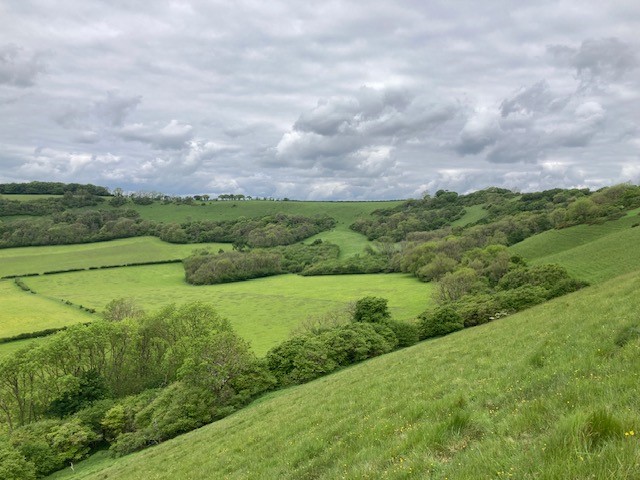
A large BCA extending from the Piddle Valley in the west to the Stour Valley in the east. The northern boundary follows the scarp slope of the chalk with high points at 255 metres above sea level at Bell Hill, 260m at Lyscombe Hill and 274m at Bulbarrow. The dip slope is characterised by a more gently undulating landscape, now largely arable farmland, with chalk streams in the valley bottoms; Bere Stream. Devil’s Brook, North Winterborne and the upper reaches of the River Piddle all flowing south. Villages are centred on the valleys with the older buildings and churches built of brick and flint.
Parts of the BCA are well wooded with both ancient stands and recent plantations, especially in the northeast of the area around Milton Abbas and Shillingstone. Ancient woodlands are either on steep scarp slopes or overlie deeper clay-with-flint deposits that are less suitable for cultivation. Many were formerly coppiced but there is little management carried out in the smaller woods which has negatively affected invertebrate and bird populations. Ash is an important canopy tree in many woods and Ash-dieback will have a significant impact in the medium and long term. At Turnworth Common there is a rare example of a grazed wooded common on the chalk with a significant number of veteran trees and also Holly and Hawthorn. Recent survey work has shown the site to be of regional importance for beetles associated with dead wood features.
The majority of the remaining semi-natural chalk downland is on the steep scarp slope and the heads of dry valleys, the grasslands have a rich flora with a number of scarce species including Bastard Toadflax, Early Gentian and Dwarf Sedge. There are important butterfly populations locally particularly on the shorter southerly aspects with colonies of Adonis Blue, Dingy Skipper and Grizzled Skipper.
In the river valleys grassland were widely managed as water meadows in the past but very little semi-natural grassland survives. The rivers themselves are fine examples of chalk streams, some are seasonal only flowing in the winter months. The ecology of the streams is linked to the abundance of Stream Water-crowfoot with which many of the invertebrates are associated. The Piddle and its tributaries are home to Salmon, Sea Trout, and Bullhead.
Settlements include a number of large manor houses which had landscaped parklands and amenity plantings surrounding them. The surviving trees support a rich assemblage of lichens including a number of nationally declining and threatened species with Anaptychia ciliaris and Physcia tribacioides of particular note.
The Central Chalk BCA falls within several Landscape Character Areas: North Dorset (escarpment chalk ridge), Upper Piddle Valley (chalk valley & downland), Upper Milborne Valley (chalk valley & downland) and Upper North Wimborne Valley (chalk valley & downland). It covers 30,872 hectares.
Summary of Key Features
- Semi-natural chalk grassland on steep valley and scarp slopes with a rich flora and important butterfly populations
- Ancient woodland on steep and scarp slopes
- Parkland and veteran trees around old manor houses
- Chalk rivers and associated habitats
Issues:
- Fragmentation of chalk grassland and butterfly populations
- Lack of appropriate grazing to maintain the grassland habitats and species they support
- The potential loss of Ash trees in ancient woodlands and the wider countryside due to Ash Dieback
- Loss and lack of replacement of field trees
- Enrichment of watercourses
Species assemblages of importance within the BCA
- Butterflies and day-flying moths of grassland
- Plants of ancient and unimproved grasslands
- Fungi of ancient and unimproved grasslands
- Invertebrates of species-rich scrub & scrub edges
- Plants of ancient woodland
- Fungi of old growth woodland
- Lichens of old growth woodland
- Fungi of wet woodland
- Invertebrates of wet woodland
- Saproxylic invertebrates associated with veteran trees and dead wood features
- Woodland birds
- Woodland bats
- Plants of species-rich hedgerows & hedgebanks
- Plants of old droves, green lanes & Holloways
- Invertebrates of species-rich hedgerows & hedgebanks
- Lichens of mature and veteran wayside and pasture trees
- Birds of lowland rivers
- Lichens & bryophytes of churchyards
 Dorset Environmental Records Centre