Biodiversity Character Areas have been developed by DERC to sit alongside Landscape Character Areas. They describe the landscape type and land use, main semi-natural habitats present and highlight species, species assemblages and features of particular interest.

Click here for a list of Key Species (coming soon)
Farming dominates this large area and it has shaped the landscape over centuries. The fields are irregular in shape pointing to an ancient landscape where enclosure occurred early. Mature Oak trees form a feature of the many old hedgerows with more scattered Ash and Maple. Traditionally it is an area of dairy farming but in recent years there has been an increase in beef cattle with maize grown widely on drier ground. Semi-natural grassland is now rare and largely confined to former ancient common land. It is characterised by an abundance of Corky-fruited Water-dropwort plus scarce and declining plants such as Sneezewort, Dyer’s Greenweed, Meadow Thistle, Pepper Saxifrage and Spiny Restharrow. Invertebrates of note include the very local Forester moth and Dingy and Grizzled Skippers. Damp fen-meadow vegetation with an abundance of Devil’s-bit Scabious provides a habitat for the rare Marsh Fritillary, plus the Dingy Mocha moth and the hoverfly Microdon myrmicae.
Scrub is an intrinsic component of grassland, particularly Blackthorn which is the larval foodplant for Brown Hairstreak, the area supporting the only Dorset colonies. Dense Blackthorn scrub is also the favoured habitat for Nightingale in one of its few remaining Dorset sites.
Ancient woodland is scattered across the area with many small ‘farm woods’ and larger fragments in the former Forest of Blackmore and at Melcombe Park. There is an ancient deer park at Stock Gaylard with many veteran trees and a rich assemblage of epiphytic lichens. In the south of the area at the foot of the chalk there are small wet Alder woods found around springs and alongside small streams. The flora includes local species such as Alternate-leaved Golden-saxifrage, Herb Paris and Thin-spiked Wood-sedge. Piddles Wood situated on Kimmeridge Clay above the River Stour has a particularly rich flora with Wild Service Tree and Midland Hawthorn, both rare in Dorset as native species, plus Goldenrod, Orpine, Common Cow-wheat – all local and declining woodland plants. Woodland butterflies include Purple Hairstreak, Silver-washed Fritillary and White Admiral, while the hoverfly Cheilosia semifasciata has its only Dorset site here.
The Vale has numerous small streams many arising at the foot of the chalk and draining broadly north and then east to the Stour, except the River Wriggle in the west that flows into the River Yeo. Many of the streams are lined by mature Alders and Willows. Both Otter and Water Vole are present here along with Kingfisher and Grey Wagtail.
The Vale has many small villages with the older buildings and churches built of honey-coloured Oolitic limestone from quarries around Sherborne and Marnhull. Churchyards are an important refuge for a wide range of species. They enclose small areas of semi-natural grassland and veteran trees, while the old walls and memorials are habitat for a good range of lichens.
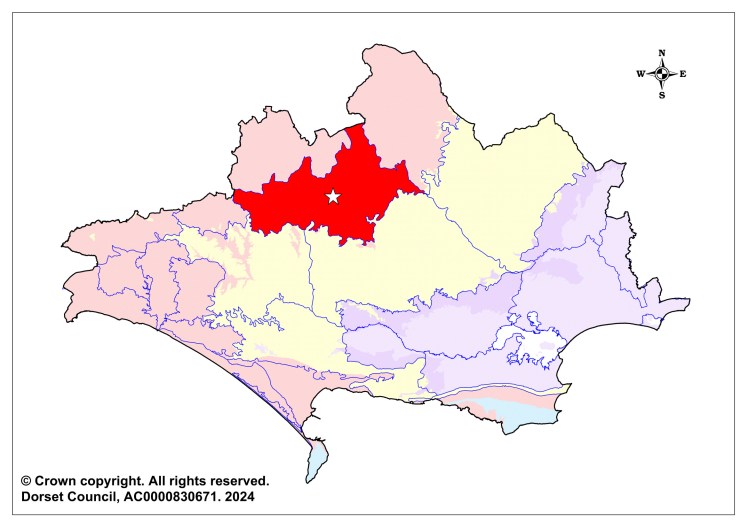
The Blackmore Vale West BCA falls within the Blackmore Vale West Landscape Character Area (clay vale & rolling vale) and covers 20,760 hectares.
Summary of Key Features
- A distinctive hedged landscape with hedgerow trees particularly Oak
- Remnants of once extensive commons at Alner’s Gorse, Deadmoor and Lydlinch with semi-natural grassland, fen-meadow and a rich invertebrate fauna
- Tributaries of the River Stour including the River Divelish, River Lydden & Caundle Brook
- Villages built of local limestone stone with Mediaeval churches
Issues:
- Loss and fragmentation of semi-natural grasslands
- Enrichment of road verges with rank nutrient rich vegetation replacing semi-natural grassland vegetation
- Enrichment of watercourses
- Loss and lack of replacement of hedgerow and field trees
Species assemblages of importance within the BCA
- Plants of ancient woodland
- Plants of wet woodland
- Fungi of old growth woodland
- Fungi of wet woodland
- Lichens of old growth woodland
- Lichens of mature and veteran wayside and pasture trees
- Saproxylic invertebrates associated with veteran trees and dead wood features
- Invertebrates of wet woodland
- Woodland birds
- Woodland bats
- Plants of ancient and unimproved grasslands
- Plants of rush-pastures & fen-meadows
- Fungi of ancient and unimproved grasslands
- Butterflies and day-flying moths of grassland
- Invertebrates of fens, fen-meadows and basic flushes
- Plants of species-rich hedgerows & hedgebanks
- Invertebrates of species-rich hedgerows & hedgebanks
- Plants of old droves, green lanes & Holloways
- Churchyard lichens & bryophytes
 Dorset Environmental Records Centre