Biodiversity Character Areas have been developed by DERC to sit alongside Landscape Character Areas. They describe the landscape type and land use, main semi-natural habitats present and highlight species, species assemblages and features of particular interest.

Click here for a list of Key Species (coming soon)
Farming dominates the Vale with a mixture of dairy, beef and a small amount of arable on drier ground. Much of the farmed landscape is characterized by irregular shaped fields divided by old and ancient hedgerows, many with fine Oaks. In the north the historic Royal Forest of Gillingham covered a large area between Shaftesbury and Gillingham and north to the Wiltshire border. Old maps show many ponds in the Gillingham area some of which have survived and the Blackmoor Vale is a stronghold for the Great Crested Newt.
Ancient woodland is rare within the area with Duncliffe Wood on the Greensand by far the largest. Partially replanted the with conifers it is now owned and managed by the Woodland Trust who are removing exotic tree species and promoting natural regeneration of native species. Other important ancient woodlands include Fifehead Wood and Kingsettle Wood.
Sloping ground on the Greensand around Shaftesbury has small remnants of semi-natural neutral grassland most notably at Breach Fields SSSI. Corky-fruited Water-dropwort is characteristic of these grasslands with Dyer’s Greenweed, Pepper Saxifrage, Betony and Devil’s-bit Scabious, plus a number of waxcap fungi.
Much of the area is in the watershed of the River Stour fed by the River Loddon and numerous smaller tributaries. There is little semi-natural grassland remaining in the floodplain, the few surviving areas support Marsh Marigold, Meadowsweet and Meadow-rue. The Stour locally has a rich flora most notably the rare Loddon Pondweed found in shallower parts with a gravel base. Yellow Water-lily, Spiked Water-milfoil and Shining Pondweed are frequent. The margins have tall emergent species, Bulrush and Branched Bur-reed, plus the much scarcer Flowering Rush and Inland Club-rush. White-legged Damselfly is a speciality of the Stour with the Brown Hawker dragonfly more widespread. Scarce Chaser is a more recent colonist of the upper Stour preferring stretches with a lush marginal flora. Alder are the common riparian tree with White Willow, Crack Willow and Osier widely planted. Where flooding deposits silt on the tree bases the scarce mosses Myrinia pulvinata and Orthotrichum sprucei can be found. The upper Stour catchment is now the stronghold of native Black Poplar in Dorset with scattered large trees present. These are being supplemented by new plantings using saplings propagated from the older trees.
Many of the older buildings in the towns and villages are built of local stone, mainly limestone with Greensand in the east from Shaftesbury south to Shroton. The churchyards are an important resource for biodiversity with smaller areas of unimproved grassland and several (particularly those with Greensand) are among the richest in Dorset (and Britain) for lichens with a number of nationally rare and scarce species present.
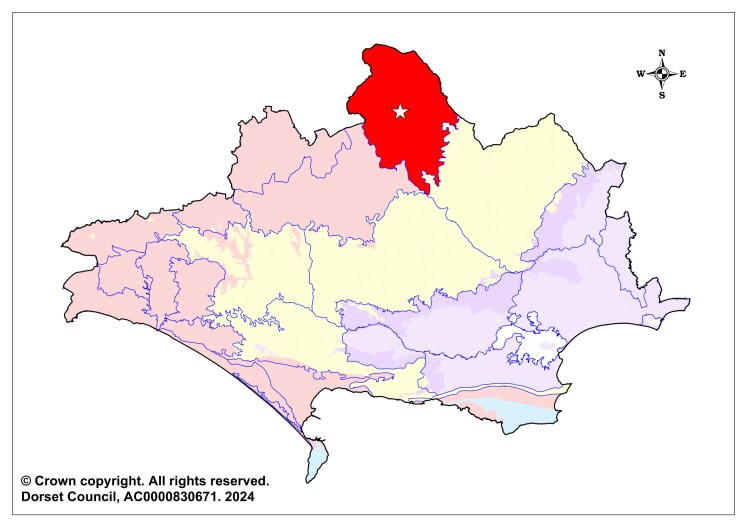
The Blackmore Vale North BCA falls within the Blackmore Vale North Landscape Character Area (clay vale, rolling vale & limestone hills) and covers 19,600 hectares.
Summary of Key Features
- A distinctive hedged landscape with a number of double-hedged green-lanes
- River Stour and floodplain
- Duncliffe Wood
- Remnants of semi-natural grassland, especially on the Greensand south and west of Shaftesbury
- Villages built of local stone
Issues:
- Loss and fragmentation of semi-natural grassland
- Enrichment of road verges with rank nutrient rich vegetation replacing semi-natural grassland vegetation
- Enrichment of watercourses
- Loss and lack of replacement of field trees
Species assemblages of importance within the BCA
- Plants of ancient woodland
- Fungi of old growth woodland
- Fungi of wet woodland
- Lichens of old growth woodland
- Lichens of mature and veteran wayside and pasture trees
- Saproxylic invertebrates associated with veteran trees and dead wood features
- Invertebrates of wet woodland
- Woodland birds
- Woodland bats
- Plants of ancient and unimproved grasslands
- Plants of rush-pastures & fen-meadows
- Fungi of ancient and unimproved grasslands
- Butterflies and day-flying moths of grassland
- Invertebrates of fens, fen-meadows and basic flushes
- Plants of species-rich hedgerows & hedgebanks
- Invertebrates of species-rich hedgerows & hedgebanks
- Plants of old droves, green lanes & Holloways
- Churchyard lichens & bryophytes
 Dorset Environmental Records Centre