Biodiversity Character Areas have been developed by DERC to sit alongside Landscape Character Areas. They describe the landscape type and land use, main semi-natural habitats present and highlight species, species assemblages and features of particular interest.

Click here for a list of Key Species
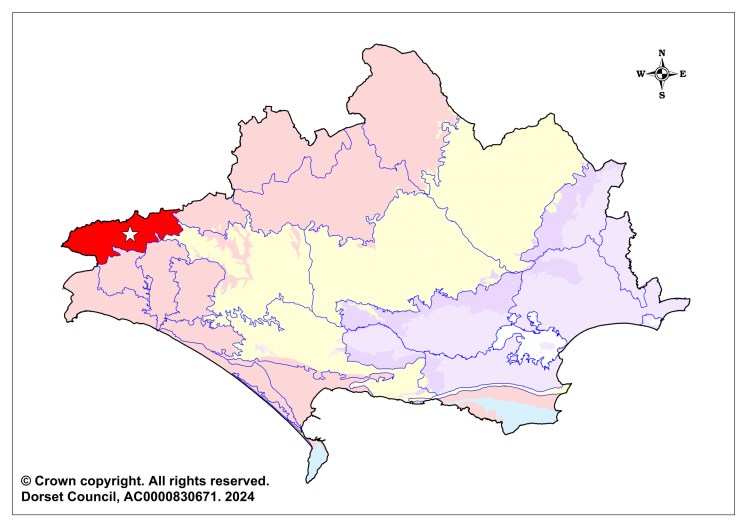
This BCA encompasses the catchment of River Axe and forms the county boundary along its western edge. The source of the river begins with springs at the junction of the Chalk-Greensand-Gault near Chedington and is then fed by numerous small streams and a few larger ones, including the Temple Brook, River Synderford and Blackwater River. The geology of the valley is largely Jurassic clays, Frome Clay in the east and Lower and Middle Lias in the west, with Upper Greensand forming the higher ridges at Blackdown and Thorncombe. Locally there are superficial deposits of Head and Clay-with-Flints plus fertile alluvium along the Axe floodplain. River Terrace deposits near Chard Junction are quarried for sand and gravel.
The area is very rural with five main villages and numerous scattered farmsteads. The older buildings are built of distinctive honey-coloured Oolitic limestone, originating from areas to the south and north, and of the more local Upper Greensand and Chert. Farming dominates in the area with soils and climate most suitable for grassland with beef or dairy cattle. Arable, and increasingly maize, is generally restricted to the higher and better drained ground. The fields are irregular in pattern suggesting varying stages of enclosure, with hedgerows widespread, some with hedgebanks partly made of stone, an unusual feature for Dorset. Hedgerow trees are frequent in some areas with Oak dominating. Hedgebanks and verges along the numerous small lanes retain an interesting flora including a number of scarce species such as Bitter Vetch, Common Cow-wheat and Golden-rod.
Species-rich, semi-natural grassland is now rare within the area but there are important stands of seasonally wet rush-pasture supporting local and declining plants including Ragged Robin, Meadow Thistle, Sneezewort and Marsh Arrowgrass.
Woodland is concentrated in the west of the BCA with stands of ancient woodland and more recent plantations associated with the Forde Abbey and Sadborow estates. Many of the semi-natural woodlands are small and on steeper slopes or on wet ground along small streams.
The Axe Valley & Hills BCA includes the Axe Valley Hills (wooded hills) and Axe Valley (undulating river valley) Landscape Character Areas and covers 6,926 hectares.
Summary of Key Features
- River Axe and small tributaries and associated habitats
- Parkland and associated plantings around Forde Abbey
Issues:
- Loss and fragmentation of semi-natural grasslands
- Loss of field and hedgerow trees with no replacements
- Enrichment of road verges with rank nutrient rich vegetation replacing semi-natural grassland vegetation
- Enrichment of watercourses
Species assemblages of importance within the BCA
- Plants of ancient & long-established woodland
- Woodland bats
- Woodland birds
- Plants of ancient and unimproved grasslands
- Plants of rush-pastures & fen-meadows
- Plants of species-rich lowland rivers
- Riparian dragonflies & damselflies
- Invertebrates of muddy & gravelly river margins
- Plants of species-rich hedgerows & hedgebanks
- Invertebrates of species-rich hedgerows & hedgebanks
- Breeding farmland birds
 Dorset Environmental Records Centre