West Dorset’s Reticent Botanist
By Peter and Margaret Cramb
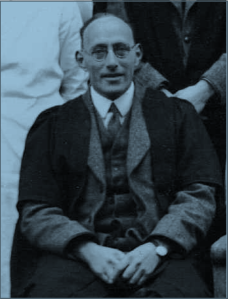
The obituary of Arthur Graveson provided by his family describes him as “an unambitious, retiring man of private pleasures”. Dorset botany has benefited enormously from those “private plaesures”, as is clear from Graveson’s archive in the Natural History Manuscript Collection of the Dorset County Museum. The archive includes Field Club record books from his many years at Beaminster Grammar School and his Natural History Notebooks. The museum also has a large collection of his botanical photographs.
Born in Hertford in 1893, Arthur William Graveson’s love of wild flowers developed at an early age. His father William, who managed the family drapery business and was Chairman of Hertfordshire County Education Committee, published British Wild Flowers, their Haunts and Associations in 1919, while his mother was a botanical artist.
Graveson was a pupil at Bootham School, York, where he began his habit of keeping natural history notebooks. He won entrance scholarship in Mathematics to King’s College, Cambridge, but transferred to reading Natural Sciences. He graduated with a double first. As a Quaker, Graveson was a non-combatant during the First World War and joined the Friend’s Ambulance Unit, twice being mined while on a hospital ship.
In 1919, Graveson joined the staff of Beaminster Grammar School (then called Beaminster and Netherbury Grammar School), Dorset’s specialist school in agriculture, to teach botany and agriculture. He remained there until 1959 and part time until 1962 when the grammar school closed, becoming Deputy Headmaster. Appropriately, he was known to the pupils as “Weeds” and soon after joining, established a Field Club to record wild plants in the area around the school. He established trials of various crops and vegetables in the agricultural field. Graveson encouraged the use of photography by members of the Field Club, resulting in a Camera Club being formed in 1926, the two clubs being combined into a Hobbies Club in 1938.
Graveson also spent his free time botanising and photographing plants in Dorset, Hertfordshire and further afield; his photographs were used to illustrate evening lectures. His herbarium is in the care of North Hertfordshire Museum, Hitchin, reflecting the high proportion of Hertfordshire specimens. He made notable contributions to Professor Ronald Good’s A Geographical Handbook of the Dorset Flora (1948) and Dr. John G. Dony’s Flora of Hertfordshire (1967).
In 1936, Arthur Graveson married a nurse, Joan Hawkins, in Beaminster and they had two children, Susan and Peter.
The School Field Club
After establishing the Field Club, Arthur Graveson continued to run it throughout its existence. Members recorded plants found within a ten mile radius of the school, noting their locations and dates of the first flowering each year. This area includes the coast from Lyme Regis to West Bexington to the south, Maiden Newton to the east, part of Somerset to the north and part of East Devon to the west, giving a range of botanical habitats.
The Club’s record books act as an informal flora of the area, and show an impressive total of 862 different plants were recorded over the period from 1920 to 1928. As would be expected, many records cover that part of West Dorset close to the school. Some of the species found, such as Broad-fruited Cornsalad (Valarianella rimosa), Corn Cleavers (Gallium tricornutum) and Field Gentian (Gentianella campestris) are now regarded as probably extinct in Dorset. In addition, many others, including Allseed (Radiola linoides), Chamomile (Chamaemelum nobile), Great Sundew (Drosera anglica), Mousetail (Myosurus minimus). Night-flowering Catchfly (Silene noctiflora), Pheasant’s-eye (Adonis annua) and Shepherd’s-needle (Scandix pecten-veneris) have not been recently recorded in the area.
The record books bring to light several old prime botanical sites, which have now been substantially lost or degraded. Notable amongst these is Champernhayes Marsh, near Wooten Fitzpaine, which was drained and planted with forestry after the Second World War. An old site for Bog Orchid (Hammarbya paludosa) and many other rare plants, it is sad to walk around the area today and find just a few residual marsh plants, such as Lesser skull-cap (Scutellaria minor) and Pale Butterwort (Pinguicula lusitanica) along the forest rides. Similarly, Warren Hill, near Melplash, was a fine site for rare arable weeds, which have now been substantially lost due to the use of herbicides and artificial fertilisers to improve agricultural productivity.
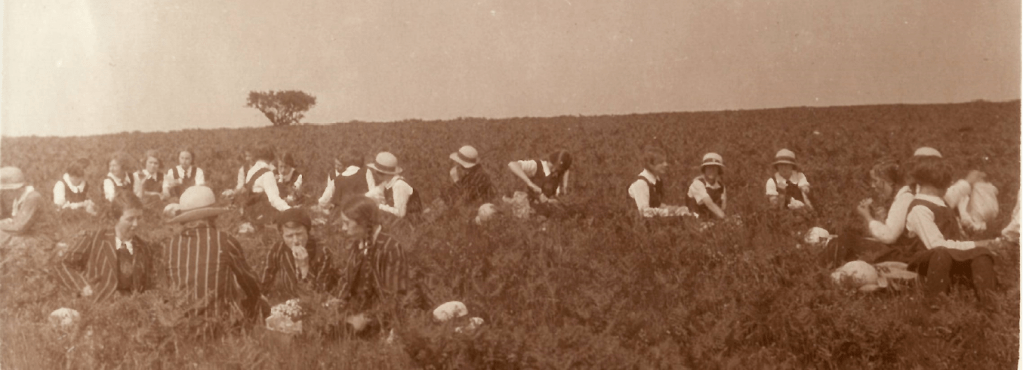
The Field Club rules were detailed and rigorous, reflecting Graveson’s high personal scientific standards. Pupils were awarded points for the first recorded flowering of a plant each year, the rediscovery of a rare species not recently recorded, and for the first records by a club member of a species within a ten mile radius. In the latter category, the number of points awarded was 12 for species which were undoubtedly native, 6 for those completely naturalised, but probably introduced originally, and 3 for casuals or garden escapes. Full membership of the Club was not granted automatically to all pupils, insteadm it had to be earned by exhibiting a collection, written work or drawings, by reading a paper or lecturing, or by obtaining a sufficient number of points in the ways described above. From the large number of pupils listed in the record books it appears that they enjoyed the somewhat demanding and competitive nature of the club.
His Personal Natural History Notebooks
Arthur Graveson’s Natural History Notebooks, covering the period October 1919 to April 1925, are a treasure trove of information about his life in the early post-war period.
Throughout, there are details of the weather at the time. There was very little rain in the summer of 1921: on 29th July the diary entry reads, ” Cousin John (in Verwood) is very hard up for water and has to fetch it from a bog on the heath 1/4 of a mile away” and, in his summary of September, he says, “Dorset in particular is very short of flowers owing to the long continued drought.” We learn that it was a fine day for the wedding of Princess Mary, daughter of George V, on 28th February 1922. It was a public holiday and Graveson enjoyed a walk to Pilsdon with the boys and a picnic lunch there. On 10th January 1923, “There has been too much rain for football, so the boys went for a run”. Again, on 25th February 1925, “Weather too bad for games, very heavy showers at intervals. Found Box, Thalecress and Rue Leaved Saxifrage in flower by the White Sheet Road.”
It is fascinating to read of the collapsing cliffs along the coast. He write on 27th September 1924, “I did not find much on the cliff path (from Lyme Regis) back to Charmouth. The cliff has fallen away to within 3 feet of the road now.” Just over two months later, he says, “There have been changes in the cliff near Cain’s Folly recently. More trees have gone over the top.” By 20th February 1925, when he went to check the coast road from Charmouth to Lyme, ” I was surprised to find the whole road had sunk down in steps of a foot or two in three or four places. The sheer drop was now separates from the main road by less than a yard of bank.”
Graveson cycled everywhere, often great distances. On 11th July 1920, “I got a bad puncture, or rather set of punctures just after leaving Axminster and was delayed an hour or more mending them.” He cycled to Blandford from Beaminster for a meeting on the 18th November 1922 and on the return trip, “got delayed a mile or two after leaving Maiden Newton by the failure of my lamp. It was pitch dark, so I had to push the cycle the rest of the way.”
Attitudes to picking wild flowers were very different in those days. On 11th March 1923, he “cycled out to the Marshwood Vale to enjoy the daffodils which are at their best right now, though many thousands are being picked every day.” However on the 17th March, “The daffodils had mostly been picked, so I could not get a satisfactory photograph of them.” On other occasions, he found the elusive Spring Snowflake (Leucojum vernum) at Wooten Fitzpaine had been “raided”, leaving very few in flower. He appeared to go where he wished, without worrying about public access, as indicated by such remarks as “It looked a bit private, but I made a fairly thorough search” and “Trespassed a bit to get across to the Broadwindsor Road, near the middle of Clan Hill.”
The Notebooks are an interesting supplement to the Field Club records, bringing to life botanical discoveries. For example, on the 16th May 1921, “I cycled out to Melbury Park… Coluchium [autumnale, Meadow Saffron] occurs in some of the meadows, especially the large one just W of the house and church. Last year Mr. S lost 4 or 5 cows through their eating the leaves, which come up early in spring. It appears they are innocuous when made into hay.” The majority of the entries in the Notebooks give detailed descriptions of Graveson’s outings, mainly in Dorset but also in Hertfordshire and elsewhere, and list many of the plants seen, thus enabling subsequent botanists to retrace his steps.
Changes in the West Dorset Flora since Arthur Graveson’s time
Arthur Graveson’s botanical records reflect the West Dorset countryside as it was in the 1920’s and 1930’s before the impact of modern farming practices. Of all the plant habitats covered in the records, it is, predictably, grasslands and arable farmland which show the greatest losses to the present day, with many species now extinct of substantially reduced in numbers in the area.
Woodland habitats have also shown declines in species such as the Bird’s-nest Orchid (Neottia nidis-avis) and the Greater Butterfly Orchid (Platanthera chlorantha), reflecting the increased planting of conifers and virtual abandonment of traditional management preactices such as coppicing. In the absence of such management, the ground flora of many woodlands has become dominated by aggressively colonising species such as Drooping sedge (Carex pendula). Wet areas have been drained for agriculture and forestry resulting in losses to their plants, with the tragic destruction of Champernhayes Marsh perhaps being the prime example. Many habitats have also been adversely affected by substantial declines in the number of grazing animals, which has lead to an increase in rank vegetation and scrub encroachment, with resulting losses of species.
Some habitats, however, show remarkable stability and his records of the plants found on the Chesil Bank, or the eroding cliffs between West Bay and Lyme Regis, show little change today. Away from the coast, some individual records show surprising continuity: for example, Narrow-leaved Everlasting-pea (Lathyyrus sylvestris) is recorded by Arthur Graveson from “near the first milestone out of Bridport on the Dorchester road”. He comments that “it is recorded in this exact locality in Flora of Dorset” (Mansel-Pleydell 1895): it remained in this place on the verge of the A35 in 2018! In addition, many Nature Reserves, including those managed by the Dorset Wildlife Trust, such as Kingcombe Meadows, remain oases where the vegetation is often similar to that in his time.
Re-finds of Arthur Graveson’s Records
Since moving to West Dorset in 2000, the authors have botanised extensively in the area covered by Arthur Graveson’s records. In the course of this we have re-found several of his records at sites not previously located since the Second World War. These include Common Gromwell (Lithospermum officinale) and Upright Chickweed (Moenchia erecta) at Thorncombe Beacon, Sea Arrowgrass (Triglochin maritime) and Sea Sandwort (Honckenya peploides) at West Bay and Sheep’s-but (Jasione montana) near Pilson Pen.
These finds encouraged us to search systematically for more of his records not recently re-found. As nearly all records were made prior to the introduction of the Ordnance Survey grid references, this task was not easy, although some of his descriptions are sufficiently detailed to enable sites to be re-found without difficulty after nearly a century. For example, he describes a site for Upright Chickweed at Pilson Pen as “near the gate opposite the lane down to Pilson village on grassy ground”, which enabled us to re-find a colony of the plants without difficulty. Similarly, he gives a detailed description of a site for Small Teasel (Dipsacus pilosus) north of Waytown. Our first search in 2017 failed to find the plants, but remembering that they are biennials, we returned in 2018 to be rewarded with a healthy colony of 15 plants!
Although many of these searches have proven in vain, there have been several other surprises, including Common Gromwell on the cliffs near Charmouth and Little Mouse-ear (Cerastium semidecandrum) on East Cliff, West Bay. These re-finds indicate that, in addition to their historical importance, his records are still of a practical use today in directing searches for rare and interesting species. It also shows that the losses since his time are not always as extensive as might be implied by Humphry Bowen’s Flora of Dorset or The Rare Plant Register.
Arthur Graveson died on the 2nd November 1979, after a long life well spent. Although he did not seek to publicise his work, his archive leaves a lasting record of the state of West Dorset flora between the World Wars, before the dramatic changes which have occurred since. They also provide an evocative and charming record of a country schoolmaster’s life in an era which now seems remote.
Acknowledgements
The authors are very grateful to the Dorset County Museum for kindly allowing them to use the Arthur Graveson’s archives in their Natural History Manuscript Collection as the basis for this article. We are also most grateful to Beaminster Museum for their considerable help in locating the photographs used in the article.
References
BOWEN, H. J. M. (2000) The flora of Dorset. Pisces Publications.
DORSET COUNTY MUSEUM Natural History Manuscript Collection Boxes XIV-XVII GRAVESON, A. W.
EDWARDS, B., PEARMAN, D. A. (2004) Dorset Rare Plant Register. Dorset Environmental Records Centre in conjunction with the Botanical Society of the British Isles.
MANSELL-PLEYDELL, J. C. (1895) The Flora of Dorsetshire. Privately printed.
PRESTON, C. D., PEARMAN, D. A., DINES, T. D., Eds. (2002) New Atlas of the British & Irish Flora. Oxford University Press.
WOODLAND, Derek R. (2005) Beaminster and Netherbury Grammar School: An Account of the Endowment and Subsequent History of a West Dorset Grammar School. Privately published.
!
!
“
! #
$
%
#
 Dorset Environmental Records Centre